When someone tips you off to a fresh roadkill porcupine in town, there’s only one place to turn: YouTube.

We’ve all been there. You wake up on Saturday morning, not sure what they day will bring. You get a text from a friend that there’s a freshly hit porcupine in the end of their street. You do some YouTube research on collecting porcupine quills from roadkill, load your trunk with gloves, a knife, and a box lined with newspaper, and you hit the road.
Ladies? Am I right?
Wait, what?
Let’s back up. Ever since I noticed porcupines traveling through my yard, I’ve had a desire to get my hands on some porcupine quills. They’re used in jewelry and crafts and I just think they’re kind of fascinating. That was the extent of my motivation.
Considering the pain inherent in asking a live porcupine to borrow some quills (however politely), and the fact that I can barely kill a spider let alone an adorable porkie, I waited patiently for a third alternative to present itself, and my patience paid off. On the way to some errands the other day, I saw a freshly killed porcupine on the side of the road. I though to myself, “well, that’s probably the least unpleasant alternative”, and slowed down slightly. Then I came to my senses, saying to myself, “I’m not THAT Alaskan yet”, and drove on.
I mentioned this to a friend while we were out shooting guns (stay tuned for that episode of life in Alaska). You know what they say about putting an idea out into the world and it will manifest itself? Later that week I got a text from the same friend letting me know that a big porcupine had been hit on his street, and was resting in peace near the STOP sign.
I wanted the “Alaska experience”, right?
If ever I’m going to go collect porcupine quills from roadkill, it might as well be when I’m living in Alaska. And as long as I’m living in Alaska, I might as well embrace the adventure of it all. Right?
So I went on YouTube to see how I might go about borrowing some quills from our dear departed friend. If it involved anything invasive or bloody I was probably out. To my delight, I found a few very helpful videos for removing quills from dead porcupines, and they were very doable. In fact, much easier and cleaner than I anticipated. I also learned that fresh kills are essential, otherwise you may bring home fly eggs on the quills that will hatch into hungry maggots. Good tip.
The procedure
I didn’t know what I’d find, if I was going to have to adopt the whole carcass and transport it home, how much gore would be involved, so I packed a large plastic bin lined with some newspaper, rubber gloves, a knife, and a cardboard box, and hit the road.
When I arrived, I gave myself a pep talk, got out of the car and walked over to him with the knife in my gloved hand.
His little feet. Were. Beautiful. I saw the bottoms of his feet, rarely visible under all of the quills. It just reaffirmed my assessment that porcupines are absolutely adorable creatures.
I crouched near his tail, and proceeded to follow the instructions from the video – I placed the blade of the knife near the base of the quills on his tail and essentially just scraped them, along with the guard hairs, into a small cardboard box. This pulls the quills out of the skin. Porcupine fact: they do not shoot out their quills. They just puff them out and then run towards you to stab you. They easily detach from their skin to stick in you while they escape danger, a feature that came in handy when I decided to removed some.
Feeling gradually more comfortable with the uncomfortable situation, I collected quite a few quills from his tail, thanked him, and took my treasures home.
How do you clean porcupine quills?
Very carefully.
I found some YouTube videos on this as well, naturally. I tried in vain to acquire some hydrogren peroxide (we’ve been out of it for a while because of the pandemic), and settled for Bactine. I proceeded to clean and sort them, very carefully. I only stabbed myself 3 times, which is quite impressive considering how may quills I handled. The whole process took quite a while, but was oddly meditative and calming. Details:

- Transfer quills from box into glass jar, research on YouTube
- Buy Bactine
- Fill jar with Bactine and boiling water, and shake, let soak
- Fill jar with dish soap and boiling water, and shake, let soak
- Empty water out of jar by pouring contents through a flour sack towel
- Discover that the quills are sticking to, or through, the towel
- Accept the fact that I will have to remove the quills and separate out the guard hairs one by one
- Using tweezers, do that sitting on the front porch listening to the rain
- Based on what I learned about the towel method, poke tons of tiny holes in an old plastic Feta cheese container to use as a sieve instead for final rinsing of separated quills
- Lay quills out to dry until you decide what you’re going to do with them


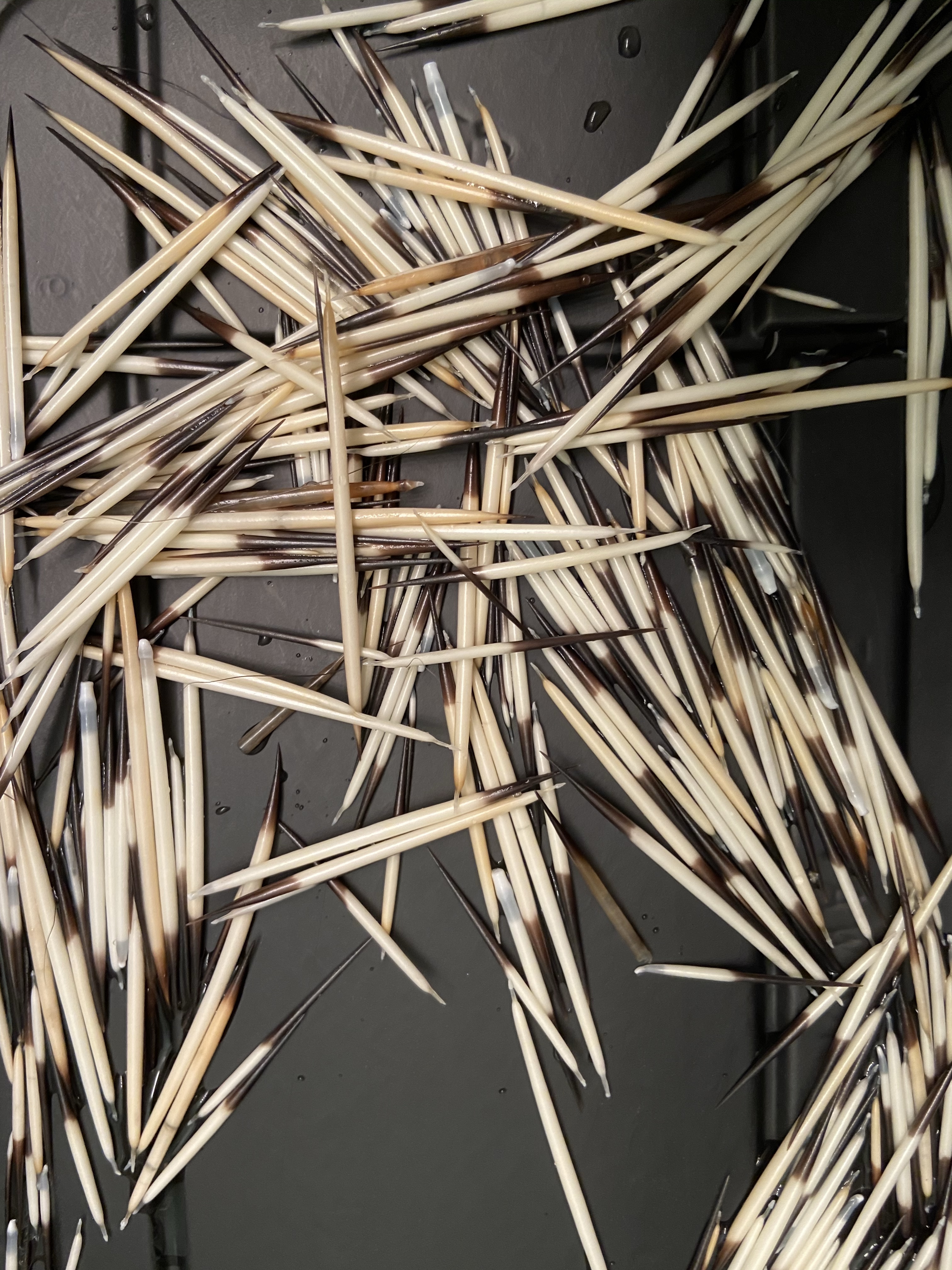
The final products
The quills:

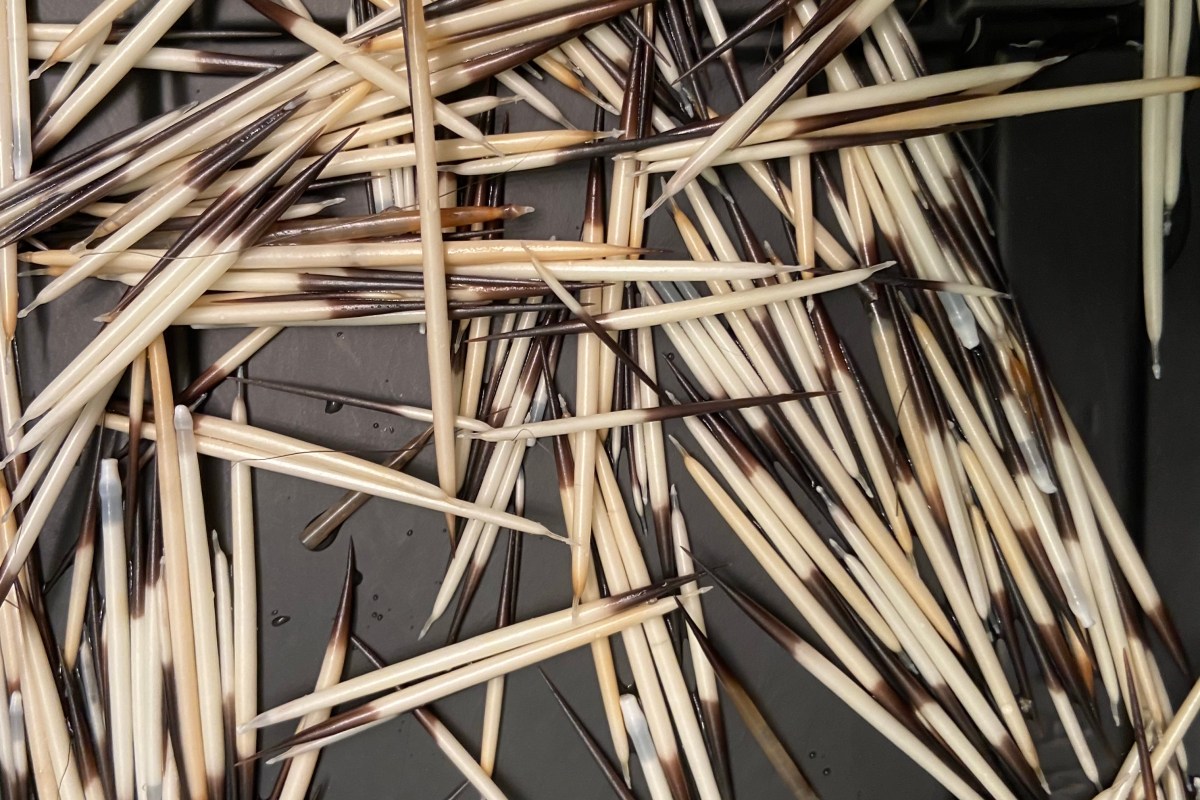
North American porcupine quills are not really as long as you think, particularly the tail quills. The quills I collected were generally about 1.5 – 2 inches. They’re kind of like plastic straws that taper at the ends. To make them more pliable, you can soak them in warm water then bend them like you would a straw.
The quills have barbs at both ends that are sharp and hooked. I stabbed myself 3 times, but didn’t break skin because I wasn’t approaching the quills with a lot of force. It hurt like any small stabby object, like a pin prick. I wouldn’t want a limb full of them.
Porcupine quills are used in a variety of art / craft situations. I later learned that the tail quills are sought after because they are thick enough to hollow out and use as beads.
Guard hairs:

The guard hairs are just really thick hairs, sort of like miniature flexible quills. They have tiny little hooks on the end that goes into the porcupine’s skin. They’re also used in arts primarily as a textile, like horse hair. They weren’t my target, but they came along for the ride.
Final impressions

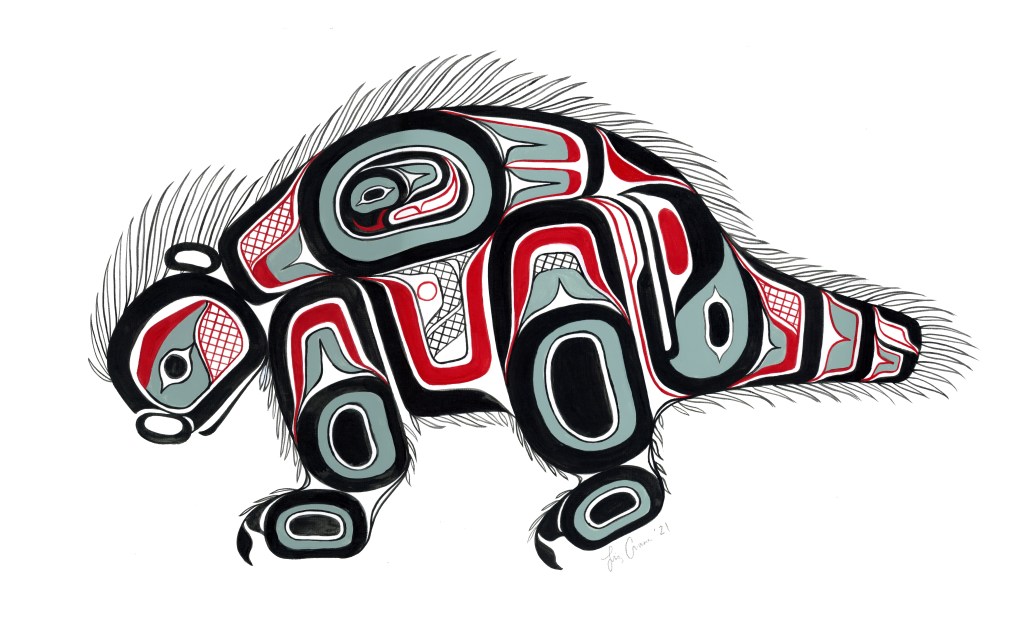
No regrets. I learned a lot, gave the porcupine’s quills a second life, and can add this to my growing list of “random skills acquired in Alaska”. I think I’m going to try to make a formline porcupine as my next project for Northwest Coast design to thank my quill donor.
Alaska skill – unlocked!
UPDATE: The final porcupine piece I designed with coaching from Wayne Price at UAS, a tribute to my quill donor.


Cute story, so well done. An interesting adventure, will anticipate hearing your shooting adventure and see your quill project.
Wish we could visit you, see Alaska.
LikeLike
Cute story, so well done. An interesting adventure, will anticipate hearing your shooting adventure and see your quill project.
Wish we could visit you, see Alaska.
LikeLike